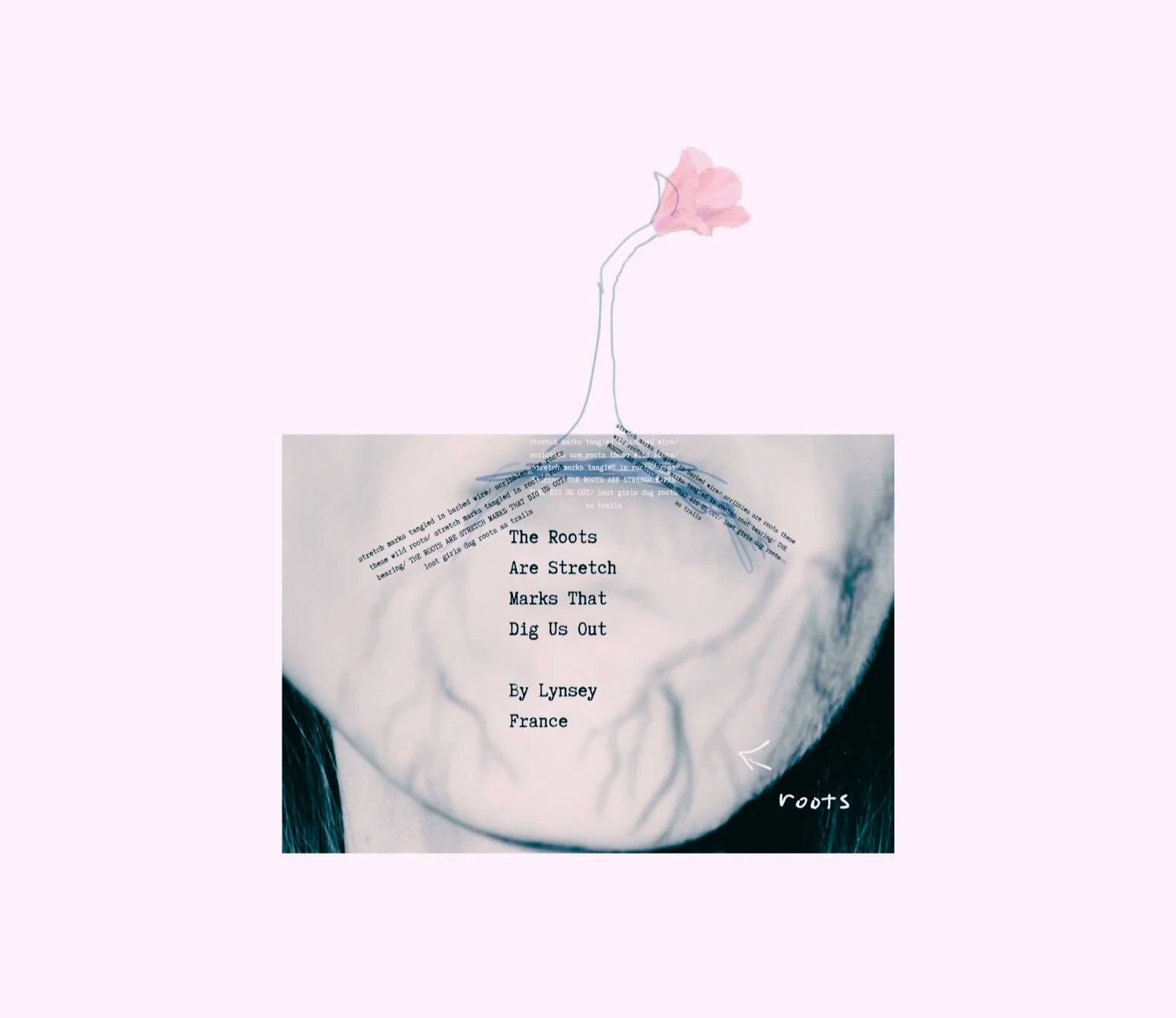
The Roots Are Stretch Marks That Dig Us Out
*
The Roots Are Stretch Marks That Dig Us Out *
Lynsey France
*
Lynsey France *
The Roots Are Stretch Marks That Dig Us Out is a textual and visual mastery in barbed wire poetics. Strung, trickling pieces of girlhood are tough against the pores and open the body of the reader into the mind of the child poet. Armed with linguistic play and small, holy artworks, France approaches this blood trail with a hungering rot, seeking an epilogue to the late winters of youth.
Lynsey is a young writer and textile artist living in Kentucky.
The Roots Are Stretch Marks That Dig Us Out
by: Lynsey France
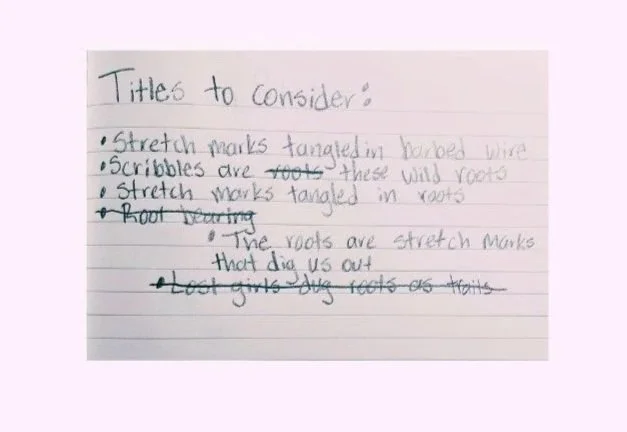
Below is a conversation between Abigail Cain and Lynsey France on France’s piece, ‘The Roots Are Stretch Marks That Dig Us Out.’
AC: We’re so happy to be a home for this beautiful manuscript. Tell us a bit about the process both in writing the piece and creating the visual art which coincides with the work. Which do you feel came first?
LF: I am very appreciative and grateful my work found the collective. Thank you for having it... This manuscript was sourced en route of my recovery--that which is still an ever-flowing stream. Foraging my language, gathering it--I found it was, and is, through memory I point myself most. Memory is where I’m coming from, here, in the act of mending its wounds... Creation is this journey with no linear destination, which is the freedom of it. This sense of trust, or faith... Likewise, neither my art or words come first. They, together, are that symbiotic relationship of two enveloped hands straying towards something familiar I can’t entirely name. Perhaps one translates the other, guiding the words, the hand, the brokenness of it into one...
AC: The ache of the work bleeds between different ages, ranging from girlhood at nine to girlhood at eighteen. They’re found in transition within the work. How do you feel these ages manifest themselves in the development of the child poet? Why did these specific years call to you in the creation of this piece?
LF: These particular years were those of a developing language. I never let my hand guide me until I understood it would find me lost and detached. I never understood the ache until I let it cradle me younger. I never thought to call this writing until I pointed towards the unknown to reveal it. My sense of girlish play allowed me to dream. I’ve come to understand at eighteen to go to the ghost towns where these dreams were forgotten, and to retrieve them. I won’t claim I am made of souvenirs, though I can say I favor the weight of the history I carry like seeds to plant rather than to bury.
AC: Who are some of your biggest inspirations?
LF My mother has complete ownership to this space. The one who wears the fires I fix so that I do not get burnt. It’s why she’s shorter, I imagine, slowly sinking to ash. She is the one who reminds me, without words, while burning, to fight. To love those fighting against you. To tell the one with the matches and plastic jug of gasoline ‘Here, take my hand, I can save yours from making this worse.’
AC: What’s next for you as a writer and artist?
LC: This is a sentence I often leave to write itself...